Showing posts with label hajj. Show all posts

Thursday, September 15, 2016

British Ambassador to Saudi Arabia Converts to Islam

Darkness at noon

It was announced a few days ago that Simon Collis, 60, the British Ambassador to Saudi Arabia, had converted to Islam and recently completed the Hajj pilgrimage to Mecca. Apparently he had converted to Islam in 2011 before marrying a Muslim woman, though it was not publicly announced at the time. I assume his superiors knew of it.

As a quasi-secret Muslim, perhaps the first Muslim convert in modern British diplomatic history, Collis had three of the most important and sensitive assignments in the Middle East - Syria, Iraq and now Saudi Arabia.

As the article below points out, Collis is certainly not the first Brit to "go native," the most famous example, of course, being T. E. Lawrence. But for all of his complexities, Lawrence never converted to Islam and had many critical things to say about the Wahhabi version of it practiced on the Arabian peninsula.

Of course, an ambassador should know as much as possible about the relevant society and culture. And he or she should be empathetic to the people concerned.

That doesn't include pledging one's soul to one of the foulest creeds ever created by mortal men.   

From the Daily Mail:
British ambassador to Saudi Arabia becomes first senior diplomat to convert to Islam and complete the Haj pilgrimage with Syrian Muslim wife
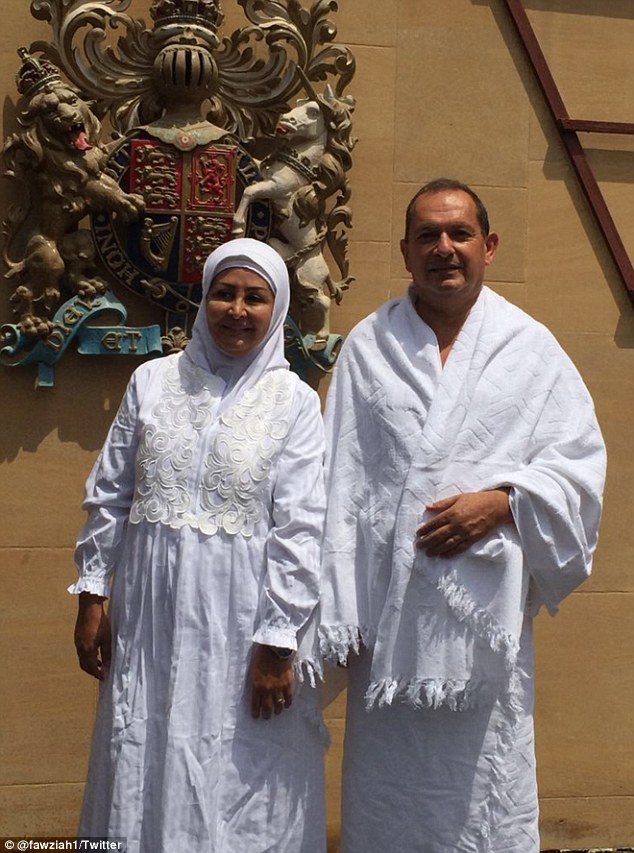
  • Simon Collis, 60, pictured with Syrian wife Huda al-Mujarkech in traditional garments
  • They made the annual pilgrimage to Mecca - a duty for every Muslim 
  • Decided to convert to Islam 'after spending 30 years in Muslim societies'
The British ambassador to Saudi Arabia has become the first senior diplomat to convert to Islam and complete the Haj.

Simon Collis, 60, said he had decided to convert to Islam 'after spending 30 years in Muslim societies'. 
The father of five was pictured in the traditional white Ihram garments worn for the annual pilgrimage to Mecca, which every Muslim must make at least once in their lives. 
Mr Collis is married to Syrian Huda al-Mujarkech. He had previously served as Britain's ambassador to Syria between 2007 until 2012, when diplomatic relations broke down between the UK and President Bashar al-Assad's regime. 
He has served in a string of Middle Eastern countries, including stints as ambassador in Iraq and Qatar and senior diplomatic positions in United Arab Emirates, Yemen, India and Tunisia. 
It is understood Mr Collis discretely converted to Islam in 2011, shortly before he married his current wife Huda. 
Converting to Islam is a religious requirement for a man marrying a Muslim woman. 
He becomes one of the most high profile British figures to convert to Islam. Most converts adopt a Muslim name but according to The Times, Mr Collis will continue using his English name. 
Mr Collis' conversion to Islam emerged after pictures were posted on Twitter earlier this week of him and his wife at the Haj dressed in the traditional Ihram robes at the front of the royal seal at the gate of the British Consulate in Mecca. 
The pictures were posted on Twitter by Fawziah Albakr from the King Saud University, who wrote in Arabic: 'The first British ambassador to the Kingdom leads the pilgrimage after his conversion to Islam: Simon Collis with his wife Mrs. Huda in Mecca. Praise be to Allah.' Mr Collis thanked her on Twitter. 
Mr Collis wrote on Twitter: 'May Allah bless you. Briefly, I converted to Islam after 30 years of living in Muslim societies and just before I married Huda.' 
The Foreign and Commonwealth Office confirmed he had converted to Islam but refused to comment on when he converted, saying his religion was a private matter. 
After leaving Damascus in 2012, Mr Collis served as ambassador to Iraq until 2014, before moving to Riyadh in January 2015. 
His first stint as an ambassador was in Doha, Qatar between 2005 and 2007. He was Consul General in Basra, Iraq from 2004-2005 and Dubai in the United Arab Emirates for four years previously. 
He was deputy head of mission in Amman, Jordan from 1996-1999. 
Mr Collis said he had converted to Islam 'right before getting married to Huda' but few knew of his conversion until the photo appeared. 
Mr Collis was among an estimated 19,000 British pilgrims performing Haj this year as they celebrated Eid al-Adha, which always begins on the 10th day of the Islamic lunar month of Dhul-Hijja, during the annual pilgrimage. 
In Saudi Arabia, more than two million Muslims descended on Mecca to celebrate the festival in one of the final rites of the Haj.

Sunday, September 27, 2015

Asra Nomani: "I Survived a Hajj Stampede"

Rush hour in hell
How would you like to go on a Hajj pilgrimage with your infant in a Baby Bjorn carrier?

Asra Nomani appears to be a "liberal" or "moderate" Muslim who believes that Islam can be reformed. I do not think she is right. And I think she is is even a bit mixed up about what "reforming" Islam (while still calling it Islam) would even mean. Do not misunderstand. In a sense I want her to be right. But I think the evidence shows that she is not.

In any case, this is a fascinating piece. And in addition to the first-person story, there is a bit about the unholy Saudi mix of fanatically religious ideology with ferocious state capitalism. This fact has been underreported in the West--that in the guise of being the protectors of the most important Muslim shrine, they have in reality destroyed most of it.

I've taken some of the more general, "pro-liberal religion" stuff out for reasons of space and relevance, and to avoid complete plagiarism. But I urge those who are interested to read the original full article.

From The Daily Beast, 24 September, 2015, by Asra Nomani:
I Survived a Hajj Stampede 
Thursday’s killing of more than 700 is a tragic reminder of Saudi Arabia’s dangerous exploitation of the Muslim pilgrimage. I should know—my baby and I were once nearly crushed, too. 
It was 12 years ago, and I was clinging to my son, Shibli, then 3 months old, outside the city of Mecca. I was caught in the kind of frightening crush that claimed the lives of at least 700 on the Muslim pilgrimage of the hajj Thursday, injuring at least 800 others, in a bloody, tangled mess of humanity slain. 
A pilgrim with my parents and preteen niece and nephew, I carried Shibli against my chest in a Baby Bjorn carrier as we fought for our lives in a stream of pilgrims seeking refuge in the tent city of Mina, outside Mecca—the same area where Thursday’s tragedy occurred. We struggled through dirty water, trash, and sleeping pilgrims beneath a bridge named for King Khaled Ibn Abdul Aziz, the wealthy heir who exported Saudi Arabia’s extremist Wahhabi and Salafi doctrine to the world, indoctrinating Muslims to radical Islam in the modern day. 
Swept in a press of desperate pilgrims, I wondered whether we would get out alive . . . 
. . . To me, Thursday’s horrific deaths—which Khaled al-Faisal, a Saudi “prince” and head of the Central Hajj Committee, callously blamed on “some pilgrims from African nationalities,” and other reports linked to a Saudi decision to block a road for VIPs—testify to some of the worst that happens to humanity when faith meets avarice. 
I wrote a book with the title Standing Alone in Mecca not because I was delusional. It is a metaphor for my lone spiritual pilgrimage, in conflict with the chandeliers, marble, and air-conditioned tents that make up the multibillion-dollar business the Saudi ruling family has built with the Saudi Binladin Group, with callous disregard to human life. The Saudi government has put in place a grandiose construction scheme for Mecca and Medina, the two holy cites of Islam, bulldozing historic relics and erecting new edifices to “faith,” complete with a luxury 44-story hotel in Mecca. The director of the U.K.-based Islamic Heritage Research Foundation, Irfan Al-Alawi, now calls the city “Mecca-hattan.” . . . 
. . . On our pilgrimage, there were many occasions when I thought we risked death in the crush of a stampede, but the worst was in Mina, where the pilgrims died Thursday. 
We were warned: “No matter what, don’t stop to pick up lost shoes. Let them go.” Otherwise we risked being trampled. Stopping for shoes was an invitation to death. 
Back in 2003, the Saudi government even warned about the dangers in a health brochure: “Dear Pilgrims, Laying under bridges and setting on the footpaths is an uncivilized behaviours, and doing so causes you many risks. so do not exposure yourself for risks.” Another one of the Saudi government’s tips seemed to defy reality: “Crowding is an important factor for transmission of meningitis, try to avoid crowded areas.” Trying to avoid crowded areas on the hajj was like trying to stay dry in the ocean. 
In that one swift moment of the stampede in which my family and I found ourselves, the dangers became apparent. The crowd started to crush us, pressing my son and me toward a wall of squat buildings on my right. Just over 5 feet tall, I had Shibli dangling at the level of the other pilgrims’ backs. I worked hard to make sure he got air, but I was afraid he’d suffocate if the crowds closed in even tighter. Trust me, my mother, nearby, was thinking: I told you so. I considered escaping into the entryway of a smelly men’s restroom but figured I would just be flattened against its closed doors. There were slippers everywhere. People had lost them and been unable to retrieve them in the crowd. 
Our guide, Muhammad Alshareef, founder of the ultraconservative AlMaghrib Institute of Islam in Canada and the U.S., warned us: “No matter what, don’t stop to pick up lost shoes. Let them go.” Otherwise we risked being trampled in the press of the crowd. Stopping for shoes was an invitation to death. 
Shibli squirmed on my chest. It was increasingly hot, and I jabbed my hand into the crowd like a linebacker, trying to protect him. 
Women and men yelled at me in Arabic. “They’re saying, ‘Put your baby up!’” Alshareef’s wife translated. 
“How?” I exclaimed. 
Suddenly, a young Egyptian-American man broke stride beside us. 
“He is my friend,” Alshareef’s wife said. “He can carry the baby!” 
I hesitated. I didn’t know this man. I could lose my baby in this crowd. I didn’t even have Shibli wearing his ID, “Card Number 34” in our tour group, because it was a choking hazard. I had a badly photocopied map of Mina into my pocket with phone numbers beside Arabic script I couldn’t read. The only instructions in English: “In case of lost,” we had to look for Mina Square 49 under the King Khaled Bridge or call a “Mr. Arafat” on his mobile phone. 
It was one of those perilous moments that mothers have faced since the beginning of time. I chose to take the calculated risk. 
I handed Shibli to the young man and tried to stay close beside him. We navigated gingerly but forcefully through the crowds. Shibli rested on the man’s shoulder. Finally, we took a turn out of the crush. We proceeded quickly to our tent, where the young man gave me back my baby. 
We tumbled into the women’s tent, where a fellow pilgrim from Mechanicsburg, Pa., wept from the frightening experience. . . 
. . . The lethal combination of big money with sacred ritual makes Thursday’s stampede and the crane disaster [when 118 pilgrims were killed a few weeks ago] a symbolic reminder of how unfettered and dangerous Saudi excess—both theologically and physically—has become. 
The Saudis have a legacy of deaths on the hajj, marked by deadly fires and stampedes. In 1975, there was a fire in a tent colony outside Mecca that killed thousands. In 1987 the Saudi government gunned down about 400 unarmed Iranian pilgrims protesting its rule. In 1990, an estimated 1,426 pilgrims were crushed to death in a stampede in a pedestrian tunnel leading from Mecca to Arafat. In 1994, 271 pilgrims were trampled in a stampede. In 1997, 343 pilgrims burned to death and another 1,500 were injured in a blaze that roared through 70,000 tents outside Mecca. The air was left thick with the smell of smoke, and burned-out buses, charred water bottles, and other blackened debris littered the ground. In 2005, another 250 pilgrims were killed in a stampede in Mina, and in 2006, an estimated 360 pilgrims were killed, again in Mina. 
In all of these incidents, spokesmen for the government blamed “divine” predetermination. 
Unfortunately, the Saudis put forward a theological directive that to die in Mecca during the hajj is a “blessing,” and people will sometimes abandon personal safety for faith, creating dangerous situations for those like myself who aren’t particularly interested in dying. As a new mother on the pilgrimage, I knew that I didn’t want to lose my son to human caprice after I had overcome so much to bring him into the world. But I had chosen to take the risk, over the more sensible protests of my mother and friends. 
From beginning to end, the Muslim pilgrimage is dangerous madness. It was madness near the Ka’bah in Mecca, as pilgrims threw themselves against its walls to try to kiss the stone. The situation at the Ka’bah reminded me of the time I wiggled my way into the mosh pit at a No Doubt concert. The hajj is a like a spiritual mosh pit. 
The frenzy was not so different from the rush that had filled the air when I watched Buddhist pilgrims stampede the stairs of the Ki monastery in the Himalayan mountains of India just to set their eyes on a holy mandala that was part of a holy pilgrimage led by the Dalai Lama. An elderly Nepali Sherpa there died in my arms when he was caught in the crush. 
When I closed my eyes on the hajj, I could see the dust storm kicked up by 200 naked Hindu yogis, called Naga babas, as they bolted for their holy ritual bathing in the Ganges River during the Maha Kumbh Mela in India. It was the same devotion that sent Jews and Christians to their pilgrimage sites. But there is something particularly dangerous about the lethal combination in Saudi Arabia of contained spaces and millions of pilgrims. 
Thursday’s tragedy occurred as Muslim pilgrims in Mina completed another antiquated and dangerous tradition of “stoning the devil,” in a ritual called ramy. The devil is symbolized in three stone pillars: Al-Jamara al-Kubra is the tallest pillar, al-Jamara al-Wusta is the middle pillar, and al-Jamara al-Sughra is the smallest pillar. 
The prophet Muhammad said that when the prophet Abraham wanted to do his rites of hajj, Satan blocked his way. Abraham threw seven pebbles at him, and Satan sank into the ground. Abraham proceeded to the second pillar and threw another seven pebbles at Satan, and again Satan disappeared into the ground. Blocked yet again at the third pillar, Abraham again threw seven pebbles. 
But the devil wasn’t the only thing to fear here. In 1998, a stampede in the plain of Mina killed 118 pilgrims as large crowds assembled near a bridge on their way to the devil-stoning ritual. When I was on the hajj, I went against the devil. This time, I listened to my mother and left Shibli at the tent with the women there. 
For this ritual, my family climbed a ramp onto a wide, two-level, roofless pedestrian walkway, inside which sat the three tall stone pillars. I saw giant phallic symbols rising into the sky. Trying to dodge getting hit by an errant stone flung from the other side, I threw each stone not just as a representation of my jihad, or personal struggle, against “evil” but against something much deeper. 
The birth of Islam in the seventh century was supposed to mark the end of the period of Jahiliya, or ignorance. I threw each stone as a blow against the house of greed, indulgence, caprice, intolerance, danger, and jahiliya, exported to the world from the country on whose ground I stood.

Thursday, September 24, 2015

BREAKING: At least 450 Crushed to Death in Mecca Hajj Stampede

Survivors gather around some of the victims

This is at least the sixth Mecca stampede or stampede related incident in the last twenty-five years to kill hundreds of pilgrims. The highest death toll was in 1990 when 1,426 pilgrims were trampled to death in an overcrowded pedestrian tunnel.

Higher casualty estimates are now coming in with Reuters and Sky News reporting 700 dead.

From today's Daily Mail:
At least 450 people are crushed to death and hundreds injured in stampede during Muslim Hajj pilgrimage in Saudi Arabia
  • Rescue under way after stampede in Mina where two million pilgrims were taking part in the last major rite of Hajj
  • Massive crowds gather in Mecca every year with Islam requiring all Muslims to perform Hajj once in their lifetime
  • Saudi officials use 100,000 police and large numbers of stewards to ensure safety and help those who lose their way
  • Comes weeks after crane toppled into the Grand Mosque killing more than 100 people and injuring hundreds more
At least 453 people have been crushed to death and hundreds of others hurt in a stampede of pilgrims in one of the worst incidents in years to hit the Muslim Hajj in Saudi Arabia. 
Saudi Arabia's civil defence service said rescue operations were under way after the stampede in Mina, where almost two million pilgrims were taking part in the last major rite of the Hajj. 
Amateur video shared on social media showed a horrific scene, with scores of bodies – the men dressed in the simple terry cloth garments worn during Hajj – lying amid crushed wheelchairs and water bottles along a sunbaked street. 
Survivors assessed the scene from the top of roadside stalls near white tents as rescue workers in orange and yellow vests combed the area, placing victims on stretchers and desperately trying to resuscitate others. 
It was not immediately clear what had caused the stampede.