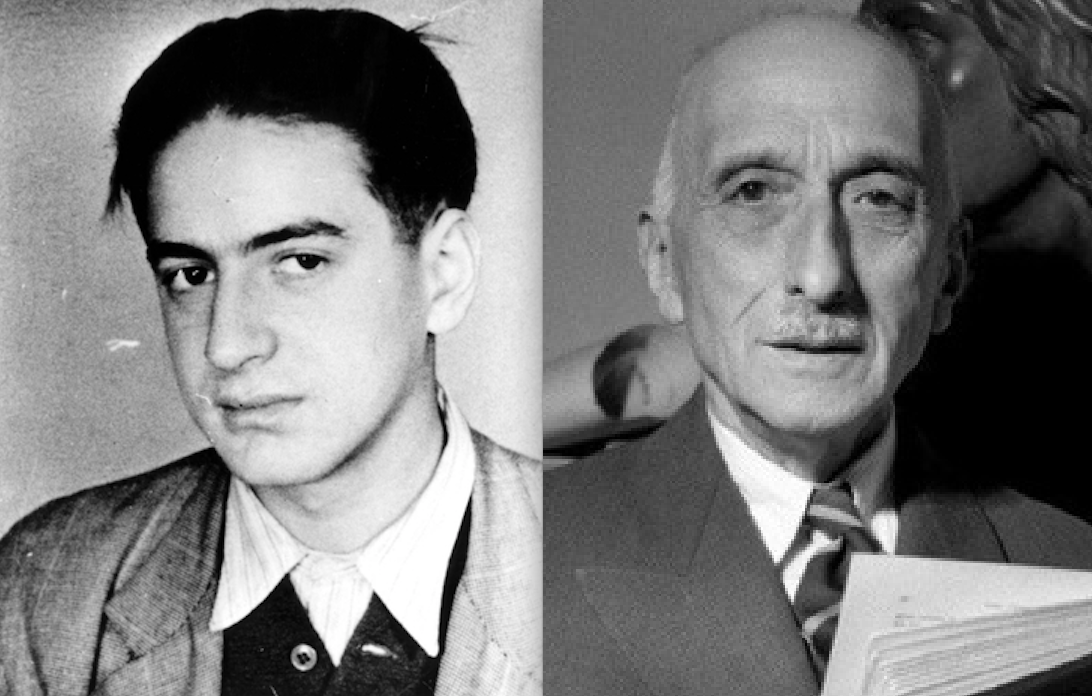
Elie Wiesel died today at the age of 87.
Some may be aware that the Jewish Wiesel published his most famous work, Night, with the help of the Catholic writer Francois Mauriac.
In May of 1955, the young unknown journalist Wiesel lined up an interview with the eminent Nobel Prize winner Mauriac in Paris.
Wiesel was twenty-six. Mauriac was sixty-nine.
The interview appeared to end very badly after Mauriac somehow offended Wiesel by uttering the name of Jesus one too many times. Jennifer Pierce relates Wiesel's response - pieced together from some of Wiesel's later writings and comments:
“Sir,” I said, “you speak of Christ. Christians love to speak of him. The passion of Christ, the agony of Christ, the death of Christ. In your religion, that is all you speak of. Well, I want you to know that ten years ago, not very far from here, I knew Jewish children every one of whom suffered a thousand times more, six million times more, than Christ on the cross. And we don’t speak about them. Can you understand that, sir? We don’t speak of them.”
Wiesel fled Mauriac’s apartment for the elevator, wanting only escape, but instead he felt Mauriac’s arm drawing him back to where they had sat. At first, all the old man did was all one can do when words fail and grief overcomes: Mauriac wept.
Wiesel said recently in an interview that, at first, it made him feel like a monster to have made this decent and wise old man, this loving man, weep so, and he felt an almost unbearable urge to flee again. This was the first whisper of love in the room — what is this love and where does it come from that it makes a man feel shame at his own torment because it injures others? But Mauriac pressed Wiesel: Tell me more. We must speak of it. And so, for a few hours at least, Wiesel spoke the things he swore never to speak, allowing his new friend to shoulder his burden with him. When they parted, the two men embraced near the elevator to which Wiesel had fled earlier; and Mauriac, who had been a member of the Resistance, said to his friend: “One must speak out — one must also speak out.”1
Not only did Mauriac encourage Wiesel to write what would eventually become Night but he added his expertise and considerable weight as of one of France's pre-eminent writers to getting it published - in France in 1958 and the United States in 1960.
Mauriac also wrote the Foreword to Night, which can still be found in current editions. Mauriac's Catholic attempt to find meaning in the Jewish Holocaust no doubt has enough to offend some in both groups:
Mauriac also wrote the Foreword to Night, which can still be found in current editions. Mauriac's Catholic attempt to find meaning in the Jewish Holocaust no doubt has enough to offend some in both groups:
And I, who believe that God is love, what answer was there to give my young interlocutor whose dark eyes still held the reflection of the angelic sadness that had appeared one day on the face of a hanged child? What did I say to him? Did I speak to him of that other Jew, this crucified brother who perhaps resembled him and whose cross conquered the world? Did I explain to him that what had been a stumbling block for his faith had become a cornerstone for mine? And that the connection between the cross and human suffering remains, in my view, the key to the unfathomable mystery in which the faith of his childhood was lost? And yet, Zion has risen up again out of the crematoria and the slaughterhouses. The Jewish nation has been resurrected from among its thousands of dead. It is they who have given it new life. We do not know the worth of one single drop of blood, one single tear. All is grace. If the Almighty is the Almighty, the last word for each of us belongs to Him. That is what I should have said to the Jewish child. But all I could do was embrace him and weep.2
Wiesel would later write of his friend:
As Pierce implies, Wiesel may have slightly misunderstood the dedication. It was perhaps intended to show not only Mauriac's own feelings but to remind his younger friend that there was another who loved him even more.When I am thinking of my personal experience, there comes to mind, as a luminous example, Francois Mauriac. I, a Jew, owe to the fervent Catholic Mauriac, who declared himself in love with Christ, the fact of having become a writer . . . . Once Mauriac dedicated a book to me and he wrote: “To Elie Wiesel, a Jewish child who was crucified.” At first I took it badly, but then I understood that it was his way of letting me feel his love.3
Notes:
- Jennifer Pierce, "Bearing Witness, Francois Mauriac and Elie Wiesel," in Crisis Magazine. See also, "An Interview Unlike Any Other" in Wiesel, A Jew Today.
- Wiesel, Night.
- From Antonio Monda, ed., Do You Believe? Conversations on God and Religion.
