Showing posts with label pope francis. Show all posts

Friday, April 5, 2019

Pope Francis Tweets that Lent is about "Fasting from Sin"


Fasting from sin? Does that mean I can do two venials as long as they don’t equal a full mortal?

One wag added:


Unlike his nemesis Donald Trump, Francis does not make his own tweets. I believe he signs off on them but usually does not compose them.

But someone seems a bit confused about fasting.

I should point out that another Twitter user found something like the "fasting from sin" terminology in Catholic tradition:


At least one other Father referred to "true fasting" in a similar fashion. My own feeling, based on the examples I've seen, is that this sort of usage is more metaphorical or poetic than directly illustrative.

Steve Skojec and Trent Roman got into a friendly argument about what St. John Chrysostom meant or was saying. With respect to Trent Roman, I agree with Steve on this:
Francis is talking about fasting from sin. One cannot fast from a thing that is evil. The purpose of fasting is to deprive a legitimate good in order to bring the appetites under the control of the will and strengthen virtue. 
What Chrysostom is saying is that the POINT of fasting -- the honor of it; why it attains merit -- is not because food is bad, but because it helps us to stop sinning because by it, we gain self control.
Granted that doesn't seem to be quite how Chrysostom put it.

But Jorge Mario Bergoglio is no John Chrysostom.

One could make a few additional points. Of course we should always abstain from sin, not just during Lent. And, all things being equal, we should usually abstain from occasions of sin. A glutton might be advised to engage in a bit more "fasting," at least of a sort. And so on.

One of the reasons we fast for Lent is to honor and imitate Jesus' fast in the Judaean dessert. Jesus wasn't fasting from sin (which would have been a bit pointless for Him) but from food. And the angels ministered and attended Him in part because He was "hungry" not because He was suffering from sin deprivation.

So does "fasting from sin" by @Pontifex have any significance other than being yet another example of weird pop theology from the Vatican?

This Twitter user saw more sinister implications:


I agree.

But I would also make a different claim: Francis and, to be fair, much of the Church since Vatican II has often disparaged traditional Catholic practices - praying the Rosary or saying "rote" prayers in general, fasting and abstinence, confession, even the Sunday Mass obligation - as being mere hollow rituals - examples of only "going through the motions." The true Christian should be primarily concerned with just loving other people or whatever. Becoming fixated on following "rules" can often get in the way of that.

Thus they speak of giving up sin, not giving up food. At least they use the word "sin."

It's very Protestant but you can't have everything.

Another way of putting it is that externals are not that important. You have to really feel it, man.

I give up meat for Lent, and let me tell you: I really feel it, man.

I'd gladly trade two venials for a steak.

Monday, March 11, 2019

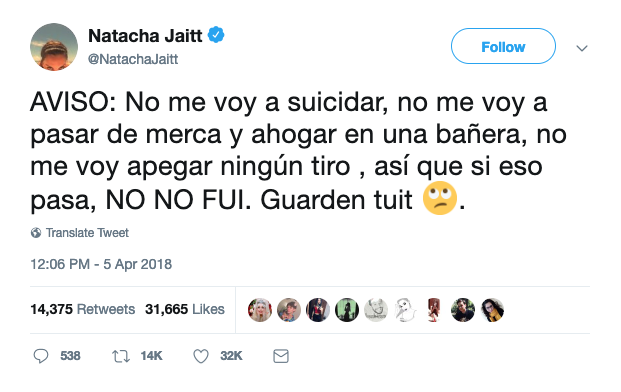
"NOTICE: I will not commit suicide. I won’t be bought off or drown in a bath tub, nor will I shoot myself in the head. So, if that happens: IT WASN'T ME. Save this tweet."


As many of you know, Natacha Jaitt's lifeless body was discovered two weeks ago. The autopsy found that she had died of drug-induced organ failure, though who administered the drugs - whether it was Jaitt herself or someone else  - has not been established.

Her lawyer believes she was murdered.

Jaitt had been an adult model (featured in Playboy, among other media), actress and escort, and more recently reality TV star and radio and television host in Spain and Argentina.

She was also a mother who left behind a son and daughter.

And of course she was also an alleged whistleblower, who claimed that Gustavo Vera, the well-known head of an anti-child trafficking organization, based in Argentina, had himself led or been part of a child trafficking operation.

Vera is a long-time close friend of Jorge Mario Bergoglio. According to Ann Barnhardt, who gathered information from Argentinian sources and media, Vera had frequently traveled back and forth between Buenos Aires and the Vatican until (according to the sources) Vera and Francis had some sort of a falling-out last year.


Francis and Gustavo Vera at Casa Santa Marta
Though Vera did return to the Vatican four days ago as a featured speaker at a Vatican conference sponsored by the Pontifical Academy of Sciences.

Jaitt had also publicly alleged that many other high-profile personalities had been involved in or had knowledge of Vera's alleged child prostitution ring.

One of those explicitly named by Jaitt was Bergoglio.

Vera had sued Jaitt for defamation, and initial depositions in the case were about to be taken when her body was found.

Since her death, there have been a number of notable developments. Among them, her business associate who had driven her to the location of her death was arrested for lying to investigators and attempting to lift Jaitt's cellphone from the scene.

Ann Barnhardt was perhaps the only English commenter to have tracked this story before Jaitt's death, though it had been a pretty big deal in the Buenos Aires media.

You can read one of her earlier stories here and there are more links here.

Complicit Clergy summarized in a video, things as they stood one day after Jaitt's death. 

And just yesterday, Miss Barnhardt went over the most recent developments for her regular podcast, here.

There is no question that Jaitt was a controversial character, to say the least. As stated, she had herself been involved in prostitution and had at one point been accused of blackmail and extortion. The Argentinian media has been on all-sides on this one, alleging criminal behavior and conspiracies by Jaitt as well as against Jaitt. And a connection with the murder of Alberto Nisman, the crusading Argentinian lawyer who was killed on the eve of presenting his findings on the involvement of former president Cristina Fernández de Kirchner in the 1994 terrorist bombing of the Jewish Center in Buenos Aires, has been alleged. Jaitt herself made the claim in a tweet made two weeks before her own death.

Natacha's Jaitt's verified Twitter account is, perhaps surprisingly, still up. Its last entry is stamped February 22, 2019. But on April 5th of 2018 she made her prophetic warning:
NOTICE: I will not commit suicide. I won't be bought off or drown in a bath tub, nor will I shoot myself in the head. So, if that happens, IT WASN'T ME. Save this tweet.

Monday, February 4, 2019

Vatican's New Document on "Human Fraternity" Co-signed by Imam Who Believes in Death For Christian Converts

Francis and Sheik Ahmed Al-Tayyeb

The Vatican just issued a "Document" to mark the current "Apostolic Journey of His Holiness Pope Francis to the United Arab Emirates".

It's called "A Document on Human Fraternity for World Peace and Living Together" and it's jointly signed by "His Holiness Pope Francis" and "The Grand Imam of Al-Azhar, Ahmed Al-Tayyeb."

As the Grand Imam of Al-Azhar University in Cairo, Sheik Al-Tayyeb is arguably the world's pre-eminent Muslim scholar.

He also is clearly on record (see below) as endorsing the punishment of death for apostates from Islam.

Notably, the current Document includes these lines:
Freedom is a right of every person: each individual enjoys the freedom of belief, thought, expression and action. The pluralism and the diversity of religions, colour, sex, race and language are willed by God in His wisdom, through which He created human beings. This divine wisdom is the source from which the right to freedom of belief and the freedom to be different derives. Therefore, the fact that people are forced to adhere to a certain religion or culture must be rejected, as too the imposition of a cultural way of life that others do not accept;
Has Al-Tayyeb changed his mind? Does he now not believe in death to apostates, though he publicly reaffirmed that at least as recently as three years ago?

Are flying pigs halal?

Mahound's Paradise wrote on this issue in 2016, during some of the Vatican's initial dalliances with the wily Al-Tayyeb. We reprint that post in full, here:

Top Muslim Ally of Pope Francis Reaffirms that Muslim Converts to Christianity Should be Killed

Cheek to Sheik

Two months ago, Pope Francis welcomed Sheik Ahmed el-Tayeb, - the Grand Imam of Al-Azhar University in Cairo, and the highest scholarly authority in Sunni Islam - to the Vatican.

And a week ago, the Pope sent a representative to Al-Azhar as a follow-up and to "relaunch dialogue."

The original meeting, which included discussions between larger delegations from Al-Azhar and the Vatican, was characterized as extremely friendly - a sort of "re-set" of Catholic-Muslim relations after the iciness allegedly set off by Pope Benedict's Regensburg remarks in 2006.

According to Vatican spokesman Federico Lombardi, in their conversation
they had focused mainly on the theme of the common commitment of the authorities and faithful of the great religions for peace in the world, the rejection of violence and terrorism, the situation of Christians in the context of the conflicts and the tensions in the Middle East and their protection.
The Pope gave Sheik el-Tayeb a number of gifts including a copy of Laudato si.

Then they spontaneously embraced.

Sheik el-Tayeb is often described as a "moderate." He looks rational and reasonable, without the crazy smile of the fanatic. He supported el-Sisi against the Muslim brotherhood in Egypt and has made a number of public statements against violent extremism and in favor of human rights in general.

A few months before meeting the Pope he declared in front of the German Parliament that the Koran guaranteed religious freedom.

However, as the Cairo Institute for Human Rights Studies recently pointed out (as highlighted by Raymond Ibrahim in a recent essay), el-Tayeb has a history of saying one thing to Western audiences and another to Arabic or Muslim ones.

For example, during this past Ramadan, el-Tayeb reaffirmed on his television show that Islam mandates death for apostates:
Contemporary apostasy presents itself in the guise of crimes, assaults, and grand treason, so we deal with it now as a crime that must be opposed and punished…. Those learned in Islam [al-fuqaha] and the imams of the four schools of jurisprudence consider apostasy a crime and agree that the apostate must either renounce his apostasy or else be killed.
The plucky Institute made a public statement calling on him to renounce this position, also making the general observation that
Al Azhar adopts two contradictory speeches: one is open and directed externally, while the other supports violent extremism, and is directed internally.
Interestingly, it appears that the statement was not released in English or referenced on the English version of the site.

What are we to make of this?

Is Pope Francis aware that his new Muslim friend appears to believe that apostates from Islam should be killed? How does this comport with the "protection" of Christians in the region? Or perhaps the Pope, in his rejection of "proselytism," does not believe that Christian converts are worthy of protection, or should not be placed in the category of "Christians." Maybe it's more of an ethnic category.

Also, converts do tend to be a bit conservative, after all.

Actually, I suspect the Pope has no idea what el-Tayeb really believes or more to the point, doesn't really care. But he does seem to care very much about publicizing how dialogue with his quasi-peer distinguishes him from his predecessor:

In fairness to el-Tayeb, as the highest Sunni Muslim scholarly authority in the world it would be difficult if not impossible for him to declare to a Muslim audience that apostates shouldn't be put to death, as this is clearly stated in the Koran, the Hadith and Islamic history and tradition. In that context, advocating the death penalty for apostates is not an unusual or extreme position at all. Indeed, polls show that most Muslims in Egypt support it. Though, again, there is a tradition of not, as it were, making a big deal of this to Western audiences.

It may even be that el-Tayeb himself doesn't himself particularly want to execute apostates.

The problem with Islam is not that all Muslims are evil. It's that all Muslims are to one degree or another beholden to an evil ideology. Many Muslims (including most women) are enslaved to it.

So, why don't they just leave?

See above.

Who speaks for them?

Not Pope Francis, obviously.

Friday, October 5, 2018

Jeepers, Creepers, Where'd You Get That Stang?


The man they call Pope Francis was roundly mocked for the bizarre ferula he wielded for the opening of the Synod on Youth on Wednesday.

He was Gandalf. It was a slingshot, etc.

Some wag even modified a photograph to use the fork as a "V" for Vigano.

As far as I know, Catholic commentator Ann Barnhardt was the first to identify it as a stang or Wiccan forked staff.

The stang as such seems to have been invented by mid-20th English occultist Robert Cochrane. Cochrane led the life of an English eccentric, though it would end tragically. He founded two covens (the first broke up due to factional infighting), and maintained an ongoing feud with a rival pagan sect leader. Later he got into a tiff with his family over a claim that he came from a long line of magicians. His Wikipedia entry includes this priceless line:
His nephew, Martin Lloyd, has refuted that the family were ever Witches, insisting that they were Methodists.
Cochrane cheated on his witch-wife, who then threatened to hex him. A few months later he committed suicide by ingesting belladonna on Midsummer Eve. He was thirty-five.

But I digress. 

Sarah Anne Lawless, a contemporary self-proclaimed witch, describes the construction of a stang as follows:
Many make a stang according to Cochrane’s instructions – a tall forked piece of Ash wood with an iron nail in the base, two arrows crossed at near the top and a wreath circling them. This is tradition specific, a stang can be made from any type of wood and instead of being naturally forked one could top a staff with a goat or deer skull or bind antlers or bull horns to the top with rawhide to create the fork. A stang can be any height – from three feet to six feet. I use a three-foot three-pronged Hawthorn staff myself. 
To give it an added function, some witches put a candle between the tines or screw a hook into the wood to hang a lantern from. This is practical as well as representing the light of cunning and wisdom.
From Green Witchcraft III: The Manual, Volume 3

The Bergoglio stang incorporates the requisite iron nail as a crosspiece at the top. Perhaps it could be used to hang a lantern from, representing the light of cunning and wisdom.

Where did he get that stang?

Francis claims that it was a gift from "youth" to be used at the Synod on the same.

Miss Barnhardt posted a picture apparently verifying this.


But if you look carefully, there's another interesting detail. The woman on the left (who according to reports is a not so young thirty years of age) is wearing a red string bracelet, which Barnhardt describes "as a very common talisman in witchcraft/Wicca and Kabbalah, which is basically a hybrid of Talmudic Judaism and witchcraft."

Apparently, it's worn by all the youths.


Is Bergoglio a Satanist? I don't know. I mean it's not like he performs religious rituals wielding a stang or anything.

But to be serious, while in the face of this wicked circus, it's often healthy to laugh, it would be foolish to laugh this off. If the Catholic faith is true, and thus Satan and Satanism exists, if heresy and heretical prelates are on the move, and if Satan is ultimately behind this, as the Catholic Church teaches, why wouldn't we now be seeing such a link?

What do you think heretical antipopes do?

Or, more to the point, what does Satan do with them? 

Read the two recent pieces by Ann Barnhardt here and here.

I think she gets it precisely right:
As I have said and written before, one of satan’s most clever moves has been to foment, encourage and push mentally ill and demonically oppressed people to LOUDLY broadcast insane, ridiculous, totally false “conspiracy theories”. We all know the types and categories. Mind control beams, “chem trails”, shape shifting lizards, underground civilizations, flat earthers, the list goes on and on and on. 
What this has done is make it almost impossible to point out, discuss, and warn about ACTUAL sinister goings-on and actual, honest-to-goodness conspiracies that are very real . . . 
I am morally certain that Antipope Bergoglio’s carrying of a Stang with the iron nail so prominently positioned, into the opening of a farce synod whose entire agenda is the ratification of sodomy, is a clear case of manifestation of satanism. 
And if that makes me a conspiracy theorist, so be it. Some conspiracies are real.

Tuesday, August 7, 2018

Pope Francis Scarecrow Wins First Prize


This is a straw man.

I don't think it's an anti-Francis (or pro-Francis) thing, nor necessarily an anti-Catholic thing. People at the Durrow Scarecrow Festival simply like making scarecrows, often with topical themes. I actually think the Francis scarecrow is pretty good, largely because it is, well, large. And the fact that it waves when a button is pressed is a nice touch.

Let me take some of that back. It probably is a somewhat anti-Catholic thing. Poking unfriendly fun at popes in pope mobiles goes back a generation or more. I suppose this shows how, despite the love that much of the secular world has for Francis, the fact that he is still allegedly a Catholic pope is a bit of a negative. Mocking the papacy itself is always fair game, now more than ever in Ireland, of course.

To be honest, I found many of the scarecrows to be a bit disappointing (see here, and also pictures, below). The Trump scarecrow just looks like a mannequin with bit of straw added to its head. Its childishly drawn face recalls that horrible Spanish fresco restoration. The Lady Gaga scarecrow (from a past festival) resembles a bedraggled muppet.

There's only so much you can do with straw.

The "Scarecrow of Liberty" is creepy, which I guess is sort of the point.

The trick, I think, is to make your scarecrow giant, which, among other things, is sure to get the judges' attention. This is why the King Kong scarecrow works.

Francis will be visiting Ireland later this month.

Unless they erect a giant crucifix at the airport. That would scare him off.      

From The Irish Times, August 6, 2018:

Giant scarecrow in image of Pope triumphs at Durrow festival 
Straw creation of Pontiff in his popemobile is star of the annual show in Co Laois 
A giant scarecrow version of Pope Francis has won joint-first prize in a competition at the Durrow Scarecrow Festival. 
The pontiff is due to visit the Republic later this month. 
The massive model of Pope Francis in his popemobile was created by a group of men in Durrow, Co Laois, for the popular annual festival. 
Chairwoman of the Durrow Development Forum, Evelyn Clancy, said there had been a huge amount of interest from across Ireland. 
The festival is known for its topical depictions, from Donald Trump to King Kong. 
“People expect it, King Kong was higher than a two-storey house, people have that expectation from this group of men,” said Ms Clancy. 
The talented and creative group behind the creation includes engineers and carpenters who have put many evenings of work into their scarecrow. 
Chairman of the Conahy Vintage Club, Michael Bergin, told the Leinster Express they enjoyed the camaraderie. 
“We always think that big is beautiful. There was work for everybody in it from steel to straw, overalls, shoes down to making tea and having a chat. You make it up as you go along.” 
The group added lights to the popemobile and when a button is pressed, the scarecrow Pope waves. 
Money raised from visitors to the festival is reinvested in the community, Ms Clancy said.


Wednesday, March 14, 2018

NOT A PARODY: Vatican Leaves out Notable Final Section of Benedict's Letter - "Thanks for thinking of me, but I won't have time to read those books."


Two days ago, the Vatican published part of a letter, purportedly written and signed by Pope Benedict, referencing a new eleven-book series on Pope Francis' "theology." Among other things, the Vatican excerpted what we now know are the second and third paragraphs:
I applaud this initiative that wants to oppose and react to the foolish prejudice in which Pope Francis is just a practical man without particular theological or philosophical formation, while I have been only a theorist of theology with little understanding of the concrete life of a Christian today. 
The small volumes show, rightly, that Pope Francis is a man of profound philosophical and theological formation, and they therefore help to see the inner continuity between the two pontificates, despite all the differences of style and temperament.
This vague but still significant seeming-endorsement by Pope Emeritus Benedict for Francis and his program prompted the expected negative reactions, depressing confirmations and wild theories from the usual suspects (including me). 

However, the full text of the letter has now apparently been leaked (to the journalist Sandro Magister), and it turns out that the final part of the letter puts a slightly different spin on things. While the full letter was read out (in Italian, I assume) at the presentation on Monday, the final two paragraphs were not referenced in the press-release. Comically, while the release did include a photograph of the letter sitting on a table (in which a few words can barely be made out), the part containing the final paragraphs was covered up by a stack of books.

Here are the fourth and fifth paragraphs of the letter (from Edward Pentin at National Catholic Register via the blog of Sandro Magister):
However, I don’t feel like writing a short and dense theological passage on them because throughout my life it has always been clear that I would write and express myself only on books I had read really well. Unfortunately, if only for physical reasons, I am unable to read the eleven volumes in the near future, especially as other commitments await me that I have already made. 
I am sure you will understand and cordially greet you.
Benedict is, as usual, too kind. I'm willing to bet anyone 1,000 old Italian lira that, outside of the proof-reader, no mortal man, whatever his physical capabilities or limitations, has read or will ever read the entire text of these volumes.

I suspect even some of the works of the amazingly prolific Joseph Vissarionovich had more actual readers.

What is it about totalitarian regimes and this stuff?

In any case, perhaps the Catholic pundits all had it wrong a few days ago. Was it largely just a question of being polite? 

Thank you for thinking of me, but I'm afraid I don't have time to review the eleven items that arrived by special courier this morning. They look very professionally produced, and I'm sure they will find an appropriate audience. Unfortunately, I am engaged in a number of other projects at the moment, and I'm still three months behind with Un Posto al Sole. I hope you understand. Good luck in your endeavors!

Saturday, July 1, 2017

Pope Francis Appoints a Universalist - All Men Will Be Saved - to Replace Müller as Head of the Congregation for the Doctrine of the Faith

The new head of the CDF, perhaps illustrating the possibility of hell

To put things in simple common sense terms, everyone knows that the Catholic Church and the wider traditional Christian Church has always taught that there is a heaven and there is a hell. Ignoring the theological glosses - limbo and purgatory - Christian and Catholic teaching has been clear that upon death, some men will go to heaven, where they will dwell with God forever, and some men will go to hell, where they will dwell with Satan and the other damned, forever. This teaching is firmly based on the words of our Lord in the Bible. Open it up to any place where hell is mentioned, and you will find Jesus stating it, always in strong terms.

Even at the time of the Christian Fathers, there were those who rejected this teaching. They came to be called universalists, or those who believe that salvation is universal - all men will go to heaven. Universalism was always considered a heresy in the Christian Church, and "officially" so in the Catholic Church. This has, of course, not prevented offshoot universalist Christian sects from forming - the Unitarian Universalists being the most aptly named modern example.

The twentieth and twenty-first century has seen a growth in universalist sentiment within the Catholic Church. But, since it's the Catholic Church, which contains a recognized body of Doctrine, an official catechism of teachings and all the rest, the tendency has always been couched in language that stops short of fully and explicitly endorsing universalist claims. So to use the claims of one of contemporary universalism's most well-known spokesmen, Auxiliary Bishop Robert Barron of Los Angeles, riffing of the arguments of a few heterodox twentieth century Catholic theologians, while there might be a hell, that doesn't mean that anyone is actually in it. Or to use his own well-known formulation, we have good reason to hope that everyone will be saved.

From the point of view of logic, he may be right. But also from the point of view of logic, if he is right, then either the Gospels inaccurately recorded the words of our Lord, or our Lord is a liar.

Today, Pope Francis appointed a new head of the Congregation for the Doctrine of the Faith - the Catholic body entrusted with defending Catholic doctrine and teaching - replacing Cardinal Gerhard Müller, who had become a sort of enemy in his attempts to defend (albeit, often tepidly) Catholic doctrine from Begoglio's predations.

The new head of the CDF is a jesuit Archbishop by the name of Luis Ladaria Ferrer.

Ladaria is a universalist.

I'm not going to go into a long analytical discussion of Ladaria's publicly expressed position, but it basically tracks Barron's more well-known claims - there is a hell, but it's possible, probable, or we have good reason to hope that no one actually goes there.

Ladaria's views were laid out in the appropriately titled, Jesus Christ: Salvation of All. Here are some relevant excerpts. These are not cherry-picked, but among other things, include passages that Ladaria himself chose to read out in public, now available (of course) on YouTube:
The saving influence of Jesus and his Spirit know no bounds: Christ’s mediation is universal. Salvation in Christ is possible for all humanity, and on the horizon of theological reflection. The hope may arise that this salvation will indeed reach everyone. Salvation itself would become denaturalized if its absolute certainty would be affirmed and if we lost sight of the possibility of damnation [p. 12].
[T]his universality includes more than it excludes, among other reasons because the unique mediation of Jesus cannot be separated from God’s will of universal salvation (1Tim 2:3–5) [p. 96].
We are all called to place ourselves within the body of the [Catholic] Church, which will not reach its fullness until the whole human race and the entire universe has been completely renewed. Christian faith begins with the premise of the unity of humanity as a whole because of its origins in Adam, and above all, because of its destiny in Christ. It is inconceivable that salvation, as it is presented in the New Testament, is only for Christians and not for those who do not know Christ [p. 117].
We may also add the early Christian conviction that hell is something neither wanted nor created by God. Maintaining the possibility [my emphasis] of eternal damnation is the only guarantee of the truth and reality of the salvation offered to us, which is nothing less than God’s love [pp. 130-131].
Jesus includes everyone and excludes no one, and all of us have received his fullness (cfr. John 1:16). The universality of salvation and unity of Christ’s mediation mutually affirm each other [p. 144].
Yet by dying, he gave us life, that is the life of his resurrection. Even those who do not know him are called to this divine vocation, that is, to the perfect sonship in and through Christ. Christians and non-Christians reach this goal by virtue of the gift of the Spirit that associates us with the unique paschal ministry of Christ even if it is through diverse paths known only to God [p. 148-149].
Again, obviously, Ladaria always stops short of saying, "I'm a heretical universalist. Everyone is going to heaven." But the meaning is clear. And of course, Ladaria would never claim that he is a heretic or even heterodox to in the least. Rather, he is simply more deeply describing the evolving understanding of doctrine.

Or some such.

And as always with these things, much of what he says is undeniably orthodox. Yes, God calls us all to Him. He wants us all to be saved. Jesus died so all of us could be saved. Is he denying hell? By no means, but we do not know who is in it. Perhaps (as a matter of logic) no one is. Shouldn't we hope that to be the case? And so on and so forth.

Well, according to what Jesus said, and is recorded to have done: there were people in hell, there are now, and there undoubtedly will be many more.

No reasonable Catholic can affirm that that's exactly a comforting thought. But there are many things that Jesus said that are not exactly comforting. He was sent to teach us - with soft words and hard ones, but always true ones, and always with our good in mind - by our Father, not our touchy-feely shrink.

But here's what Christ did say: trust in me and come to me, through (as the Church He founded would from the very beginning assert) the Church I created, and you will be saved. I will save you if you sincerely ask me to. And you will live with me forever in heaven.

To me, that's the most comforting thing in the world.

The universalist version of that is a counterfeit. It's un-Christian, un-Catholic and will inevitably lead to many more souls being permanently separated from God and damned forever. It's a lie.

And the current occupant of the throne of St. Peter is spreading it.

Friday, June 23, 2017

Stephen Walford on Amoris Laetitia - The Case of the Missing Ellipsis


Steve Skojec just wrote a post at OnePeterFive, Is Amoris Laetitia an Expression of the Ordinary and Universal Magisterium, where he critiques an article of a few months ago on Amoris Laetitia. The original article in Vatican Insider, The Magisterium of Pope Francis: His Predecessors Come to His Defence by Stephen Walford, was little noticed at the time, but yesterday on Twitter, Pope Francis apologist Austin Ivereigh threw down a sort of late gauntlet to prominent opponents of Amoris Laetitia, daring them to refute the article.

Essentially, Walford argues that papal exercises of the ordinary magisterium - papal teaching authority expressed at a lower level of authority than infallible ex-cathedra pronouncements - still demand our assent. Or to put it another way, when a pope intends to teach as pope on a question of faith and morals, he cannot err, even when speaking non-infallibly. Walford argues that the statements of previous popes support this, in sources as varied as private letters, public audiences and encyclicals. Thus, the claims of Amoris Laetitia - among them, that communion should now sometimes be allowed for people living in irregular marital situations - must be accepted.

Or to put it even more simply or directly: What Pope Francis says in Amoris Laetitia must be true because he, the Pope, said it. Previous popes would agree.

Skojec does a great job of demolishing Walford's argument, and, thus, meeting Ivereigh's challenge. If you haven't already read both pieces - Walford's original and Skojec's response - I highly recommend doing so. Not only is the debate obviously relevant to Amoris Laetitia - the most contentious papal document in at least two generations - but it is also useful in understanding the general question of papal authority. Can a pope ever be wrong? Under what conditions? What is the ordinary (or universal) magisterium? And so on.

One problem is that while Walford's argument can be literally summarized in a tweet, the counter-argument cannot. And this is annoying.

Or worse than annoying. Some would argue that throwing dust is how the devil often operates. By the time you put together a complex refutation of his mix of lies, half truths and, yes, truths, your audience has fallen asleep, or stopped listening because the whole thing is too complicated to follow.

Not that Walford is the devil. For all I know, he's a fine fellow. But he's literally doing the devil's work here, whether he's aware of it or not.

Skojec summarizes the problem with Walford's argument in the final paragraph of his post. The summary is a bit longer than a tweet:
That the Church’s ordinary magisterium is infallible is indisputable. That Amoris Laetitia is an expression of it — particularly where it contradicts or calls into question the magisterial teaching that came before it — is anything but.
That's exactly right, of course, and as good a summary as any.

My contribution to the discussion - a sort of footnote - will be to make one observation about Walford's disingenuous use of sources that Skojec didn't point out (he couldn't point out everything - his post was quite long, as it is). It's the first thing that I noticed, and, indeed, the only thing that I noticed before I stopped looking, after Skojec had published.

Walford begins by using a quote from John Paul II, given at a general audience on March 17, 1993:
St. John Paul II described it as the “charism of special assistance” explaining further: “This signifies the Holy Spirit’s continual help in the whole exercise of the teaching mission, meant to explain revealed truth and its consequences in human life. For this reason the Second Vatican Council states that all the Pope’s teaching should be listened to and accepted, even when it is not given ex cathedra” [1].
My translation says, "heard and welcomed" as opposed to "listened to and accepted," but no matter. More to the point is how the excerpt ends. Due to the fact that in this instance Walford seems to have a preference for Chicago style (which eschews ellipses in certain cases) over MLA style (which requires them in those cases), it's not clear that the excerpt actually ends in mid-sentence. Let's re-do the last part in MLA style:
"For this reason the Second Vatican Council states that all the Pope’s teaching should be listened to and accepted, even when it is not given ex cathedra..." [1].
It turns out that the part that follows our ellipsis is actually crucial for understanding John Paul II's claim. Unfortunately, Walford breaks off the excerpt in the middle of a sentence. I wonder why.

Here's the second part of the sentence that he does not quote:
...but is proposed in the ordinary exercise of the magisterium with a clear intention to enunciate, recall, reiterate Faithful doctrine.
And now, the full sentence from John Paul II:
For this reason the Second Vatican Council states that all the Pope’s teaching should be listened to and accepted, even when it is not given ex cathedra, but is proposed in the ordinary exercise of the magisterium with a clear intention to enunciate, recall, reiterate Faithful doctrine.
Are you still awake?

There's the rub. Whether or not Francis had a "clear intention to enunciate, recall (or) reiterate Faithful doctrine" is the question. Since many have argued persuasively that the controversial passages of Amoris Laetitia actually contradict Church doctrine, including Church doctrine as reiterated by John Paul II himself in Familiaris consortio and Veritatis Splendor, among other places, we cannot reasonably say that he did. That he will not "answer the dubia," affirming that he did, is indeed, good evidence that he did not.

I take back some of what I said about Walford. He's a man with an agenda, and nothing will stop him from trying to persuade people of the truth of that agenda, even if it's cutting sainted popes off in mid sentence to further his case. That's not exactly innocent. Yes, what he did was dishonest. And that's merely what happens in his second paragraph with his first source. It doesn't bode well.

But in fairness to Walford, he's not unique. Defenses of Amoris Laetitia are riddled with this type of thing. Indeed, Amoris Laetitia itself is riddled with this type of thing, selectively quoting documents from, say, John Paul II or Benedict XVI to attempt to bolster the case, even when in some instances, other parts of the documents or even other parts of the same sections or even paragraphs in those documents contradict the case.

But Walford takes the cake by doing it within a sentence.

Give them their due. They have chutzpa.