Showing posts with label the holocaust. Show all posts

Monday, April 24, 2017

Holocaust Remembrance Day

YomHaShoah, 2014

As part of Holocaust Remembrance Day or YomHaShoah, sirens go off all over Israel, and everyone stops whatever it is that they're doing to stand in respectful attention.

Videos show cars slowing down to a halt on highways. The drivers also get out and stand.

It is incredibly moving.

I don't think it would be as moving and important if it were merely "remembering." But, of course, it's not. It's symbolic of the unflagging determination of a nation that long ago collectively decided to robustly defend herself - always ready to fight back against those who wish to destroy her.

France could use a bit of that.

We could use a bit of that.

Is the Holocaust the greatest evil of the 20th century? I'm not sure it is.

Perhaps there should be a Gulag remembrance day across Russia.

The Chinese don't have a remembrance day. Instead they still have a giant picture of their very own mass murderer on their most prominent government building. They're too busy making money to take him down.

But if others, for whatever reason, don't wish to "remember", that's not Israel's fault. Rather, it's a comment on what makes Israel and it's citizens different - more (I'm struggling for the right word here) clear-eyed.

More honorable (at least in that one respect)?

We should do the same thing in New York, every September 11th.

Is there a 9/11 remembrance day? I suppose there probably is - people place flowers someplace or another, or whatever. Sixteen years ago, a sort of tragedy happened, and then many of us became Islamophobic. It's all so very sad. Hatred is wrong.

Let me amend what I earlier said. We should have a Cowardice Day. (And, yes, I mean the appellation to apply to us.) It wouldn't exactly be uplifting, but at least it would be accurate.


Saturday, July 2, 2016

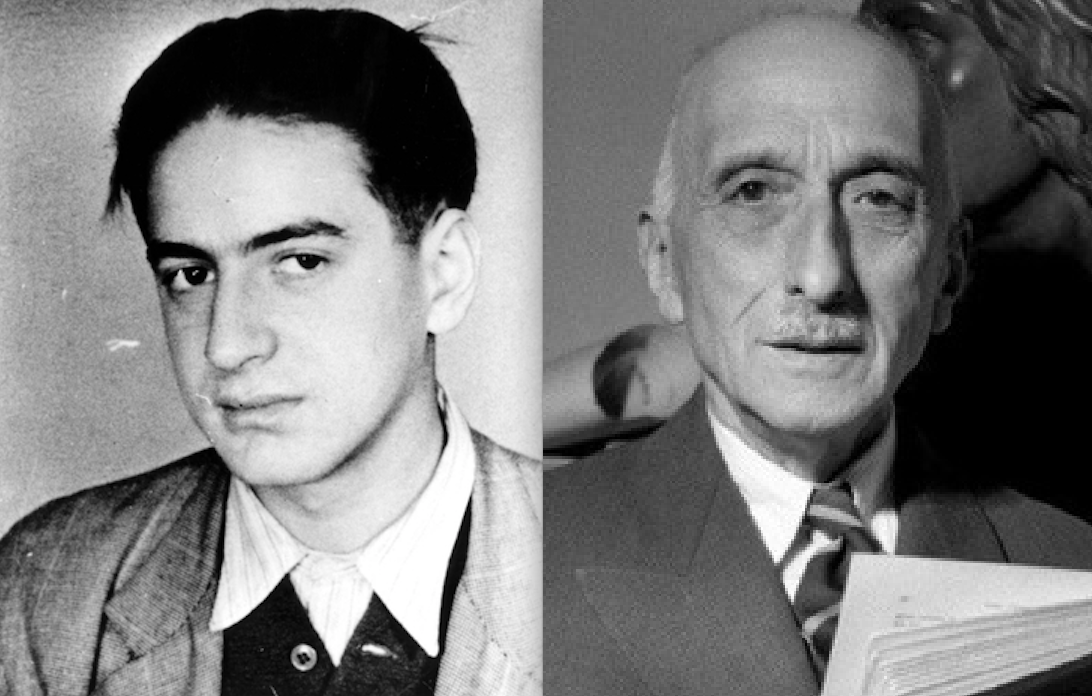
Elie Wiesel and Francois Mauriac


Elie Wiesel died today at the age of 87.

Some may be aware that the Jewish Wiesel published his most famous work, Night, with the help of the Catholic writer Francois Mauriac.

In May of 1955, the young unknown journalist Wiesel lined up an interview with the eminent Nobel Prize winner Mauriac in Paris.

Wiesel was twenty-six. Mauriac was sixty-nine.

The interview appeared to end very badly after Mauriac somehow offended Wiesel by uttering the name of Jesus one too many times. Jennifer Pierce relates Wiesel's response - pieced together from some of Wiesel's later writings and comments:
“Sir,” I said, “you speak of Christ. Christians love to speak of him. The passion of Christ, the agony of Christ, the death of Christ. In your religion, that is all you speak of. Well, I want you to know that ten years ago, not very far from here, I knew Jewish children every one of whom suffered a thousand times more, six million times more, than Christ on the cross. And we don’t speak about them. Can you understand that, sir? We don’t speak of them.” 
Wiesel fled Mauriac’s apartment for the elevator, wanting only escape, but instead he felt Mauriac’s arm drawing him back to where they had sat. At first, all the old man did was all one can do when words fail and grief overcomes: Mauriac wept. 
Wiesel said recently in an interview that, at first, it made him feel like a monster to have made this decent and wise old man, this loving man, weep so, and he felt an almost unbearable urge to flee again. This was the first whisper of love in the room — what is this love and where does it come from that it makes a man feel shame at his own torment because it injures others? But Mauriac pressed Wiesel: Tell me more. We must speak of it. And so, for a few hours at least, Wiesel spoke the things he swore never to speak, allowing his new friend to shoulder his burden with him. When they parted, the two men embraced near the elevator to which Wiesel had fled earlier; and Mauriac, who had been a member of the Resistance, said to his friend: “One must speak out — one must also speak out.”1
Not only did Mauriac encourage Wiesel to write what would eventually become Night but he added his expertise and considerable weight as of one of France's pre-eminent writers to getting it published - in France in 1958 and the United States in 1960.

Mauriac also wrote the Foreword to Night, which can still be found in current editions. Mauriac's Catholic attempt to find meaning in the Jewish Holocaust no doubt has enough to offend some in both groups:
And I, who believe that God is love, what answer was there to give my young interlocutor whose dark eyes still held the reflection of the angelic sadness that had appeared one day on the face of a hanged child? What did I say to him? Did I speak to him of that other Jew, this crucified brother who perhaps resembled him and whose cross conquered the world? Did I explain to him that what had been a stumbling block for his faith had become a cornerstone for mine? And that the connection between the cross and human suffering remains, in my view, the key to the unfathomable mystery in which the faith of his childhood was lost? And yet, Zion has risen up again out of the crematoria and the slaughterhouses. The Jewish nation has been resurrected from among its thousands of dead. It is they who have given it new life. We do not know the worth of one single drop of blood, one single tear. All is grace. If the Almighty is the Almighty, the last word for each of us belongs to Him. That is what I should have said to the Jewish child. But all I could do was embrace him and weep.2
Wiesel would later write of his friend:
When I am thinking of my personal experience, there comes to mind, as a luminous example, Francois Mauriac. I, a Jew, owe to the fervent Catholic Mauriac, who declared himself in love with Christ, the fact of having become a writer . . . . Once Mauriac dedicated a book to me and he wrote: “To Elie Wiesel, a Jewish child who was crucified.” At first I took it badly, but then I understood that it was his way of letting me feel his love.3
As Pierce implies, Wiesel may have slightly misunderstood the dedication. It was perhaps intended to show not only Mauriac's own feelings but to remind his younger friend that there was another who loved him even more.

Notes:
  1. Jennifer Pierce, "Bearing Witness, Francois Mauriac and Elie Wiesel," in Crisis Magazine. See also, "An Interview Unlike Any Other" in Wiesel, A Jew Today.
  2. Wiesel, Night.
  3. From Antonio Monda, ed., Do You Believe? Conversations on God and Religion.

Saturday, May 21, 2016

Teen Vogue Muslima is (Surprise!) a Big Fan of Hitler and the Holocaust


A Muslim woman recently took some selfies in front of an anti-Islam protest in Belgium. She "confronted" and then "charmed" the "haters." The whole thing went viral on social media. Here's the title blurb for a rhapsodic piece that Teen Vogue wrote two days ago:

Yeah. She's a total badass, alright. Social media sleuths soon found that she was a foul-mouthed anti-semite who approvingly tweeted about Hitler and the Holocaust.
There was more on other sites. Zakia Belkhiri has since scrubbed all her social media accounts, telling the BBC that "she didn’t want to look like a girl who seeks attention." But two days ago she tastefully tweeted a different view:
By the way, Sarah Harvard of Teen Vogue is a tireless author of Islamist agitprop:
Does the Holocaust count as one of the "real issues of racism"? Or is that one of the things she won't say sorry for?

Read more about Belkhiri at Pamela Geller and Breitbart.

Saturday, January 30, 2016

Probable Oldest Man in the World is Holocaust Survivor, Israeli Citizen


Born in Poland in 1903, Yisrael Kristal survived World War One, World War Two, the Lodz Ghetto, Auschwitz and the deprivations of post-war Central Europe, immigrating to Israel in 1950. How's that for beating the odds?

On a tragic note, his first children died in the Ghetto and his wife was murdered at Auschwitz. He would remarry after the war.

There is some question as to whether Kristal's age can be officially verified, as he doesn't possess any documentation from the first 20 years of his life.


Before reprinting a recent article on Kristal, I want to review some interesting facts: 
  • There are believed to be 300,000 to 400,000 centenarians currently alive, though that number has been increasing at a steep rate every year. It is estimated that by the year 2050 Japan alone will have almost that many.
  • In both the United States and Japan, an average of 100-150 people turn one-hundred every day--too many for the President or the Japanese Prime Minister to call. In the United States, they do get a letter "signed" by the President.
  • The Japanese have the highest per-capita incidence at 40 per 100,000--10 times greater than the world average.
  • The top six countries (with a per-capita incidence of 30 or higher) are Japan, Thailand, Spain, France, Italy and South Africa.
  • Spain's rate is 10 times higher than Portugal's.
  • There are only 300 to 400 supercentenarians (people who have lived to be at least 110) and only 39 people in modern recorded history who have lived to be 115. Only four are alive today.
  • The oldest person ever (whose age was officially verified) was Jeanne Calment of France who died in 1997 at the age of 122.
  • The oldest person currently alive is Susannah Mushatt Jones, born in Alabama and currently living in Brooklyn.
  • There are only two people currently alive who were born in the 19th century.
  • There are probably no more than 200,000 Holocaust survivors alive today, with "survivor" defined broadly as anyone--Jewish or non-Jewish--who suffered persecution under the Nazis in camps, prisons, ghettos or were refugees or in hiding. The number of Jewish concentration camp survivors is undoubtedly much smaller.
  • This number is shrinking at a rapid rate for obvious reasons. Museums, universities and other institutions are currently racing to document and interview as many survivors as possible.

From The Times of Israel:
A Holocaust survivor in Haifa is believed to be the oldest man in the world. 
Yisrael Kristal, 112, achieved that status this week after Yasutaro Koide of Japan, also 112, died, Haaretz reported Thursday. 
Kristal’s grandson, Oren, received an email this week from the Gerontology Research Group, an international organization that tracks the world’s over-110 set, alerting him that the Polish-born Auschwitz survivor was up for the honor. 
Upon hearing the news, Kristal said in Yiddish: “The joy of my old age.” 
To be officially certified as the oldest living man, Kristal must present documentation from the first 20 years of his life. However, Haaretz reported, the earliest official document Kristal possesses is from when he was 25. 
Born on September 15, 1903, in the town of Zarnow, Kristal moved to Lodz in 1920 to work in his family’s candy business. He continued operating the business after the Nazis forced the city’s Jews into a ghetto, where Kristal’s two children died. In 1944, he was deported to Auschwitz, where his wife, whom he had married at age 25, was killed. 
In 1950, he moved to Haifa with his second wife and their son, working again as a confectioner. 
Kristal’s daughter Shula Kuperstoch told The Jerusalem Post that he has been religiously observant his whole life and continues to lay tefillin each morning. 
“The Holocaust did not affect his beliefs,” Kuperstoch said. “He believes he was saved because that’s what God wanted. He is not an angry person, he is not someone who seeks to an accounting, he believes everything has a reason in the world.” 
“His attitude to life is everything in moderation,” she added. “He eats and sleeps moderately, and says that a person should always be in control of their own life and not have their life control them, as far as this is possible.” 
Interviewed by Haaretz in 2012, at the comparatively youthful age of 109, Kristal declined to offer a theory for his longevity, instead saying, “It’s no great bargain. Everyone has their own good fortune. It’s from heaven. There are no secrets.” 
Asked if his diet was responsible for his long life, he said, “In the camps there wasn’t always anything to eat. What they gave me, I ate. I eat to live; I don’t live to eat. I don’t need too much. Anything that’s too much is no good.”

Friday, April 24, 2015

Bill Maher and Guests Make Fun of the Holocaust

"Hey Tucker, you wanna get a couple beers and make up jokes about the Gulag?"

From the October 12th, 2007 episode of HBO's Real Time with Bill Maher:

Bill Maher: The people who are really getting tough in foreign policy are part of the House Foreign Relations Committee...they voted yesterday to once again commemorate the mass murder of six million Jews by the Nazis during World War Two. Mild Applause. This is exactly why the voters gave control to the Democrats: to send a stirring message to Adolph Hitler. 
Huge laughter from audience. 
Tucker Carlson: Unbelievable. To sell out to the Jewish lobby. Now, the Holocaust happened... 
Joy Behar: Yeah. 
Tucker Carlson: ...and it was a terrible thing, and I'm sure in a perfect world we would...take time out to condemn this, but we are doing this at the price of offending some of our key allies, such as various Arab states, factions within the current German leadership and other friends in the War on Terror. 
Joy Behar: And wait until the Duke of Windsor hears about it from his mansion in Bermuda. 
More laughter from audience. 
Tucker Carlson: What do we get out of it...what interest of ours is served by making some of our allies mad? 
Paul Krugman: (Shrugs good naturedly.) 
Bill Maher: Because there are a lot of Jews in, apparently California, and they're a lobby. It's the ultimate in special interest lobbying. 
Joy Behar: The Jews deserve attention, but timing is everything; wait a little while. 
Tucker Carlson: I like the Jews. 
Bill Maher: We all like the Jews. 
Tucker Carlson: This is all pointless... 
Bill Maher: WE ALL LIKE THE JEWS! 
Loud laughter and applause from the audience.

Doesn't this just turn your stomach?

The only problem is, I lied. The above conversation never happened.

Sort of.

Actually this exact conversation really did happen. With one small difference: they were talking about Armenians not Jews. I transcribed the entire conversation virtually word-for-word, but replaced every occurrence of "Armenians" with "Jews". I also changed a few other things to make the references match--like inserting "Adolph Hitler" in place of "The Ottoman Empire". See end of post for the actual transcript.

Please, do not misunderstand. I am not minimizing the Holocaust. If anything, I think the murder of six million Jews should be remembered a hundred times more in our current culture. Even now, seventy years later, when most of the survivors (and perpetrators) are dead. And in a number of ways (though not all), the Holocaust was singular and unique.

But the Armenian Genocide, which while killing fewer people--"only" 1 to 2 million--was one of the great horrors of the twentieth century, and, according to one report, was an inspiration for Hitler's own effort.

It isn't funny.

It shouldn't be a political football.

And politics--"timing is everything"--shouldn't carry one atom of consideration when weighed against the truth.

On this blog we've praised Maher many times. He often has spoken the politically-incorrect truth about all sorts of things when others have been silent.

But not then.

He (and his guests) for once should have just kept their mouths shut.

***

Here is what was actually said:
Bill Maher: The people who are really getting tough in foreign policy are part of the House Foreign Relations Committee...they voted yesterday to condemn, as an act of genocide, the killings of Armenians, in Turkey, in 1915. Mild Applause. This is exactly why the voters gave control to the Democrats: to send a stirring message to the Ottoman Empire. 
Huge laughter from audience. 
Tucker Carlson: Unbelievable. To sell out to the Armenian lobby. Now, there was a genocide in Armenia... 
Joy Behar: Yeah. 
Tucker Carlson: ...and it was a terrible thing, and I'm sure in a perfect world we would...take time out to condemn this, but we are doing this at the price of offending one of our key allies in the region, Turkey... 
Joy Behar: And wait until the Weimar Republic hears about it. 
More laughter from audience. 
Tucker Carlson: What do we get out of it...what interest of ours is served by making Turkey mad? 
Paul Krugman: (Shrugs good naturedly.) 
Bill Maher: Because there are a lot of Armenians in, apparently California, and they're a lobby. It's the ultimate in special interest lobbying. 
Joy Behar: The Armenians deserve attention, but timing is everything; wait a little while. 
Tucker Carlson: I like the Armenians. 
Bill Maher: We all like the Armenians. 
Tucker Carlson: This is all pointless... 
Bill Maher: WE ALL LIKE THE ARMENIANS! 
Loud laughter and applause from the audience.